Follow the Sound: Healing through Spaciousness

An unexpected practice—humming—can help dispel the excessive overthinking that can plant itself in our minds right now. The vibrations of the sound break up tension and stimulate the vagus nerve, which turns on the relaxation response… creating even more spaciousness and clarity in our body and mind.
🍂 The following essay is an excerpt from Sense Care Is Self Care: Ayurveda & Yoga for Mental Resilience by Jennifer Kurdyla. On Friday, October 9 at 10:00 am ET, Jennifer is offering a virtual Ayurvedic Yoga practice for Autumn focusing on Stabilizing & Softening. Save your spot for the live event or recording!
Listening and listening meditation have been cornerstones of my practice for the thirty years that I’ve been involved in yogic teachings. As an entry point, I offer very tactile, utilitarian forms of listening in my classes—listening to the breath, to the sounds around us—as tools for learning how to pay attention to the present moment. Following sound, we understand—and feel—what it is to notice what’s inside and outside of us, which is one of the key steps to restoring balance and harmony in the nervous system—one of the tenets of my restorative teachings.
When I first began a regular practice of listening meditation in the 1990s, I was taught a classical Buddhist technique of observing when you can no longer hear a sound. We’d sound OM together, or listen to the sound of a bell ringing, and then follow it until it disappeared. In this work, I began to pay attention to the sensory experience of listening, not just as a meditative tool for focusing the mind. Rather, I became interested in how listening helped expand my awareness. For me, it wasn’t so much about noticing the sound itself, when it began or ended, or even my interest in or appreciation for the sound. I found deep resonance in the space around the sound. I’d always been sensitive to sounds, and I still can’t handle certain loud environments, but that sensitivity turned into a gift in this practice because it helped me access the continuity of sound itself. Even when there was no more "sound" to physically hear, my attention kept spreading into the infinite space—the space in which sound rises and falls.
Sound was a way I could become more aware of this "spaciousness." Following sound allowed me to rest into the space that holds sound, and that deepened my experience in meditation exponentially. And it allowed me to enjoy meditation as an experience, not a thing I "did." So much of what I teach today is focused on spaciousness and its partner, groundedness. These two seemingly opposite qualities, in my experience and in that of most of my students, provide the necessary containers for the body and mind to come into harmony and acceptance of the present moment. I share a fairly methodical practice: first, we ground through sensing stability and consciously relaxing the body so there is a baseline of safety. Then we go into more expansive states of awareness. I already had that foundation in somatics when I ventured into these listening practices, which helped me experience them on a gross and subtle level. I could notice and feel—through sound, and all the senses, really—the constant spaciousness that sound rises and falls in and out of; in a more subtle, and to me profound, way, there was the molecular, wave-like, and vibratory quality of sound that never ceased to exist. Holding both of these at once was my huge epiphany that has since translated into how sound serves me in real life. That space for sound isn’t empty and it’s infinite; and as beings occupying space, we’re part of that continuum, which offers immense freedom and diffusion of the intensities of life. Even decades later, I feel titillated and excited that I get to teach this work. But I also feel deep gratitude for sound; it was my portal into spaciousness.
Early in my relationship with listening meditation, I took for granted that there was an inherent identification with and of the sound itself. It was the OM, the bell, or things like birds and leaves when I go out on walking meditations with my dog. There’s nothing good or bad about naming the sound as such, but it was always something I could, and did, instinctively, name. That changed when I started going to Costa Rica to lead retreats about ten years ago. My room at the retreat center sits midway in the valley of the jungle—a perch between the beach down below and the mountains rising up above me. Practicing meditation there, sound became something different. It was literal "surround sound"—monkeys and birds all jabbering and squawking in a chorus, and I had no idea when or from where a sound would come. This not-knowing disengaged my cerebral need to identify the sounds and has helped me find listening as a practice of expansion. Now even at home, when I go for walks, my ears are open like a satellite dish and I can hear with my surround sound.
A lot of people think of listening meditation as a form of concentration, where the sound is something to pay attention to. But with this experience, sound allows me to untangle from concentration and one-pointed focus. My teacher, Pema Chödrön, shares a famous teaching about disidentifying with thoughts: "You are the sky. Everything else—it’s just the weather." We lessen our grip on the content of our thoughts and our repeating narratives and let them pass through the wide container of the mind, like clouds and weather patterns. For me, "the sky" in that metaphor is listening. It widens my awareness like nothing else.
That said, not everyone needs widening and spaciousness for their practice or in a given moment. If someone is really scattered and overwhelmed, I’d choose a more focused and grounded practice. But if someone is fixated on something challenging, or on a sensation like pain, listening and widening can be supportive—even in an acute, "break the glass" situation. But always with a foundation of grounding and safety.
Learning to listen in Costa Rica, where I can’t name or predict sounds, has also strengthened my tolerance for discomfort in the emotional and even physical body. In my book Deep Listening, I write about listening to what’s difficult, the voices and sensations inside us and coming from others, and greeting them with compassion and space. This isn’t easy! And something I still practice every single day. But we have a tendency in the West around naming and identifying these difficult emotions, being very cerebral about it. This can be helpful at times, but I always return to a teaching from the great yogi J. Krishnamurti—that once you name a tree as an "oak tree," we cease to know the "tree"; the categorizing and labeling minimizes our "knowing" and awareness of the tree as a being. With my own stories that I’ve been chewing on and listening to all my life, I’ve gotten really familiar with the intellectual versions; I can be compassionate toward them, justify why things happened, and accept they’re part of my story. But that is not the same as feeling the energy of the experience that’s still in my tissues. That’s a kind of listening that doesn’t involve fixing or solving or judging, not even understanding. Like the sounds of the monkeys and the birds in the jungle, I can just be with the feelings that rise and fall and not control. We can do this while listening to others, ourselves, sensations or thoughts, and all the stuff in our lives we want to fix and change. Using the sensory experience of listening can support us in creating more space around what is difficult interpersonally and inner-personally.
I’m still fairly sensitive to sound, but experiencing the joys of this kind of listening has made me more intentional about my sound "diet." I know that lower sounds, like cello or bass, resonate with me, and I’ll surround myself with them when I can, as well as a lot of quiet. That doesn’t mean I live in a sound bubble—I still have experiences where I’m in a city with a jackhammer, or even teaching restorative yoga with a less-than-optimal soundscape nearby. In the past, that might have driven me crazy; now, I can tolerate those distractions as part of the environment, and it won’t overwhelm me if it’s not the dominant ingredient. My baseline container for sound is bigger so those wavelengths are less intense; my sensitivity has expanded my resilience for being with what’s not in my control.
There are very simple practices anyone can do to sense spaciousness through listening. Humming, singing, chanting if that’s your thing—all ways of making your own sounds—taps us into the cosmic sounds of the universe. My practice has led me to consider the difference between bound and unbound qualities of consciousness, and sound opens my antenna to that higher, unbound nature of who I am—of who we are. And when I can sense my unity with a sound wave, and realize that we’re all sound waves, the compassion I need to live my life is easier to access, too.
Āyurvedic Yoga for Autumn (Part 2)—Stabilizing & Softening
Practice with Guest Teacher Jennifer Kurdyla
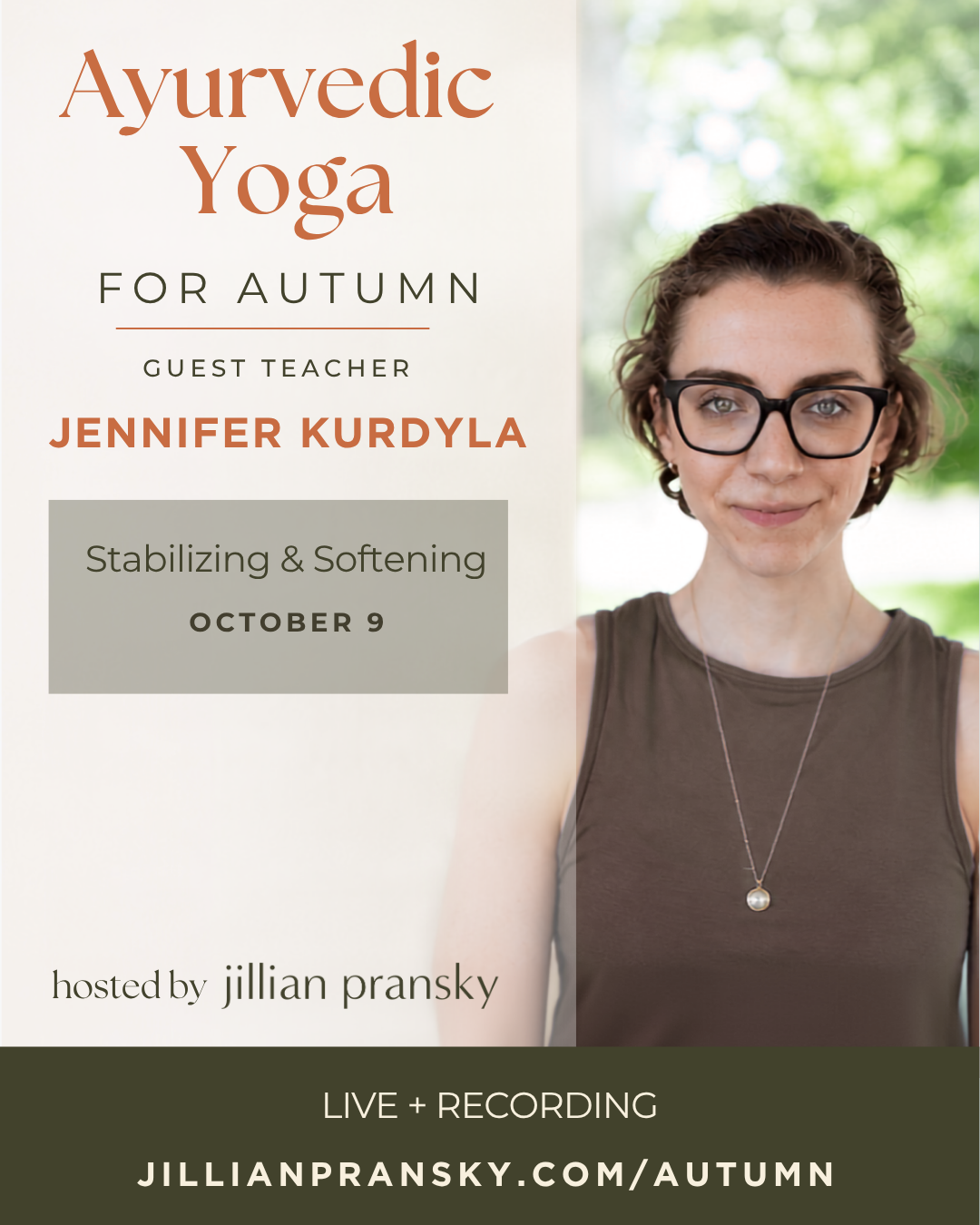
Moving deeper into the autumn season, many of us will naturally crave the comforts of cozy sweaters, warm and unctuous meals, and deeper rest. Once the heat of summer has cleared out, we can welcome these qualities with open hearts and benefit from their profound physical and energetic nourishment—which is exactly what we'll cultivate in this practice. Balancing dynamic work in the lower body and core, with smooth and rhythmic flowing sequences, we'll encourage the reigning in of our vital life force and attention, leaving us primed for a season of harvesting, reflection, and integration.
Save your spot!
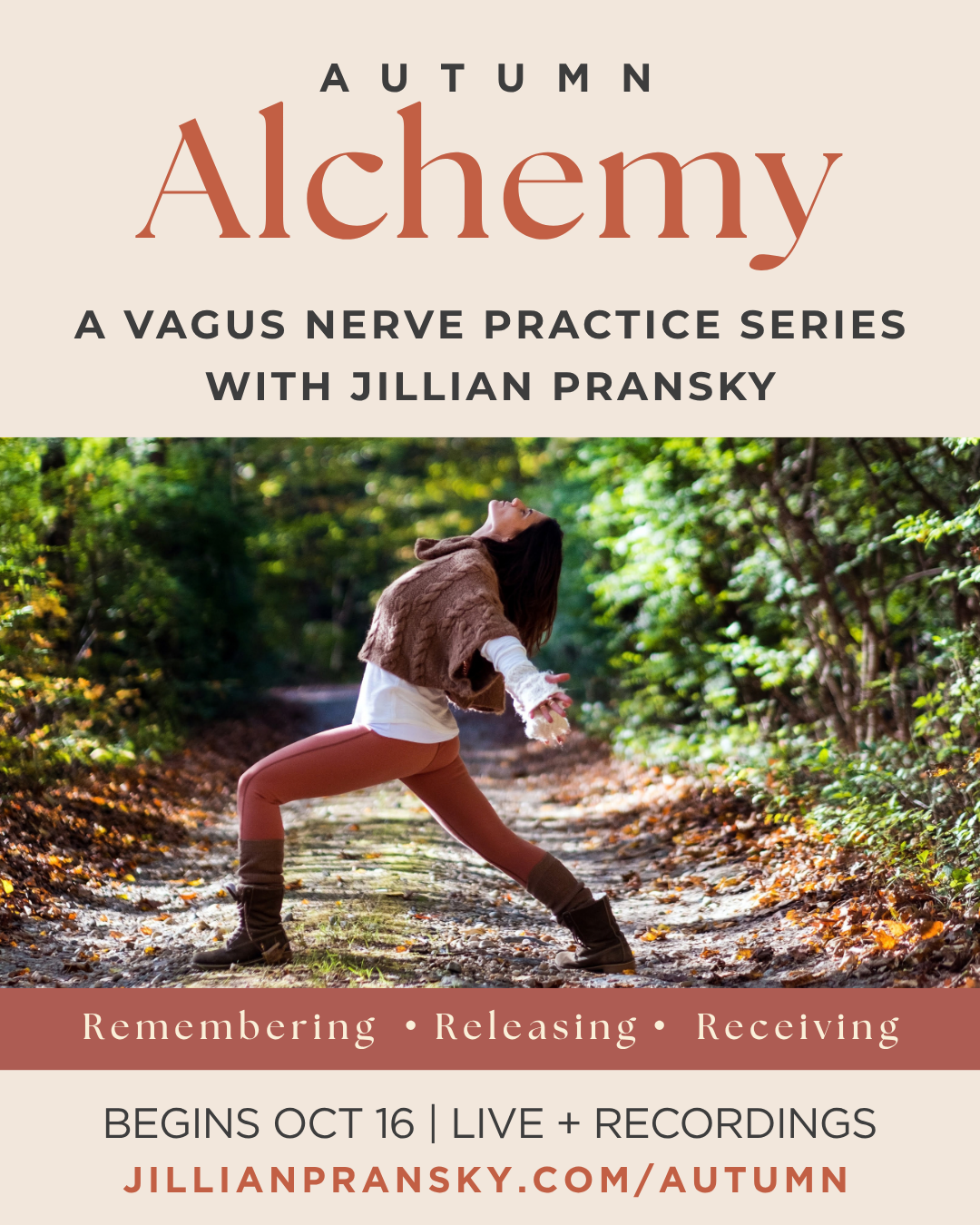
Autumn Alchemy: Vagus Nerve Practices start on October 16
Autumn Alchemy
A Vagus Nerve Practice Series
Autumn invites us to slow down, gather inward, and remember that balance is not a fixed state. It is a living relationship between effort and rest, giving and receiving, and holding on and letting go.
In this online series, we’ll explore the vagus nerve as a pathway of communication, connection, reciprocity, and transformation—listening to the body, receiving its messages, and responding with greater presence and care.
Together, these practices can help us navigate transition with greater steadiness, receptivity, and trust.
Each week includes a 30-minute yoga practice along with a 30-minute community meditation, and the series culminates in a deep mini-retreat.